
How to Price for Event Photography
Tips on Charging per Image
Contents
- Intro: Tips for Charging Per Image
- When to Charge Per Image
- Why Charge Per Image
- How to Structure Pricing for Photography
- What to Do with Customers Unhappy the Price
- What to Charge Per Image
Intro: Tips for Charging Per Image
There are two main ways photographers charge; flat fee and per image. Yes, you can get more creative with how you charge but should you?! These tips are for professionals selling to multiple customers, so all these tips focus on how to price and charge per image. These Event Photographers can include Sport Photography, Livestock Photography, Rodeo Photography, Car Shows, and more.

When to Charge Per Image
Photographers shooting shows or events where multiple people will be purchasing digital images usually charge per image. As an Event Photographer you may charge the Event a flat fee or no fee, however the customers (attendees, viewers, exhibitors, etc) will be paying per image.
Why Charge Per Image
The customer will only want to purchase their image at an event. Example; a barrel racer wants her images on the two horses she rode. She may purchase a few images available or all images available. In a rare case other people will buy an image that is not of them. But the majority of the sales will come from the subject of the photo, or their friends, family or business.
How to Structure Pricing for Photography
The main goal for pricing is SIMPLICITY.
Everything about the customer experience needs to be easy. Customers need to easily find their images, easily understand the cost of those images, and easily purchase & download them. How do you keep pricing simple? Generally, it’s better to have as few prices as possible across your website. You might need prices in different currencies if you work internationally, or types of images like formal vs candid, or type of event. Within one event have 1 - 2 prices, do you really need more? Ask yourself why you need more. Now ask yourself how easy it is to explain the different prices and if you were the customer would you understand why there is a price difference? Do not put people off by different price structures, try to have a price (or a few) that make sense and won’t put the majority of potential customers off.
Now you have a set price, how do you incentivize people to buy multiple images? Again, keep it simple! Don’t have several different coupons, offers and discount structures at one event - it is confusing and off-putting! Some people will get confused or frustrated and just give up. Others will get mad if they missed info about a coupon until after they purchased. We know that each image likely has one, or occasionally only a few, potential customers. So if there are 7 images of that one person they are really the only potential customer. If you don’t sell those images to them you won’t sell them at all. Common sense? Sure. Then why don’t people price to sell the most images possible? This does not mean low prices! This means incentive.
Example of Simple Discount Incentive
Please steal this exact discount structure - we are sharing it to help you sell more images!
You’ve decided to price images at $36.99 USD. Let’s offer the customers an automatic discount at the checkout if they purchase more than one image. Specifically the more images they buy the more discount they get. It could look like:
Up to 50% discount available. Each regular priced image you add to your order entitles you to an additional 10% discount off the next, all the way up to 50% per image. Buy more, save more. Discount automatically applied at checkout.
Example cart with base image price $36.99 with auto discount buy more, save more:
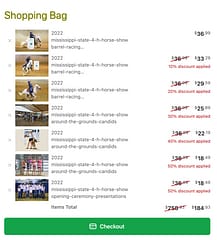
Would that customer have bought all 7 images at full price? Maybe some would, but most won’t - many might have a maximum budget for what they are willing to spend on image. But we have tracked analytics on this discount structure vs non-discount and discounting to encourage more image sales does better! People buy more than they would without the discount so the photographer is still making more money and the customer is happier because they can afford more images. It’s all about convincing them to buy that one extra image, and to increase the overall average order value as a result.
How to use Coupons
The same concept applies to Coupons. Keep it Simple and don’t overuse them - if you issue coupons all the time, people will become conditioned to expect them and won’t buy anything at full price. You’ll effectively be lowering you standard prices. So save them for special events and consider limiting them to new customers only to attract more business. Clarify the time a coupon can be used. Ensure your coupons and discount don’t apply in the checkout at the same time.
What to Do with Customers Unhappy the Price
There will always be customers that have a complaint with something. Always. This is not unique to photography. How you choose to respond is up to you. This is your business, YOU are your business. Always put your best foot forward and stick to your business structure. For example, What happens if customers missed one image or buys more later so can’t get the discount? Unfortunately the discount would not apply. You are a business. The discount is built into your website for that event and factors in things such as payment processing fees. Buying 5 images separately is not the same thing as buying 5 images together. You have clearly stated what you offer and insisting on manual handling of discounts is yet more time and cost to factor in. You can add a disclaimer that discounts apply to regular-priced digital show images only when purchased in a single order and cannot be combined with other offers. If they are a specially valued customer though you can always issue an individual discount coupon just for them to keep their good will. We use Stripe for payment processing which has this capability built into their checkout.

What to Charge Per Image
Each industry will be different as will be each country and even town. Do some research on what people priced previous years at the same event, similar event or in other areas. Make sure you will at an absolute minimum cover your costs and time by your estimated number of images sold. Never estimate for the absolute minimum or you can lose big.